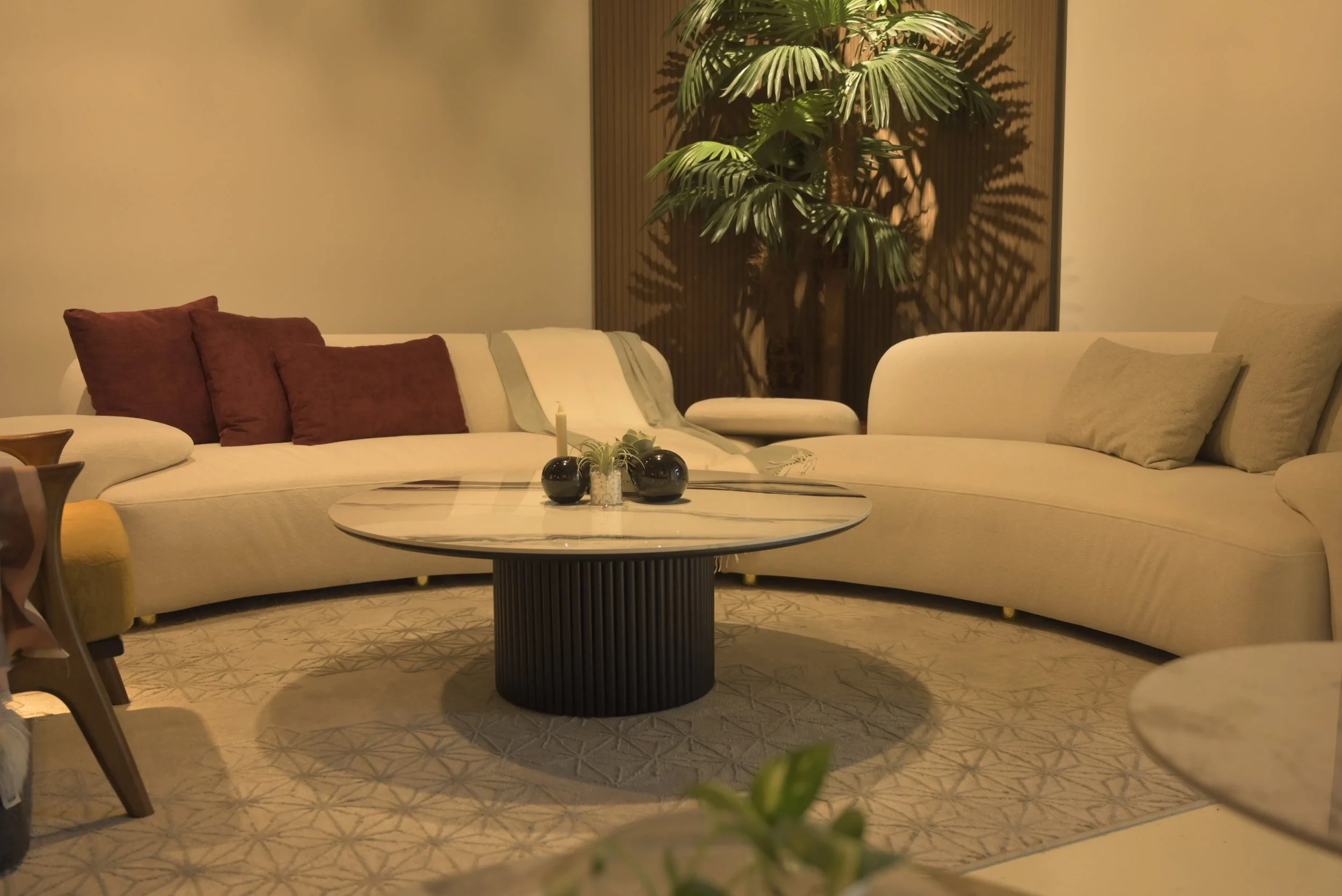
Framing spaces
Celine
November 2025
If you are a photographer, you might just understand this concept. Every time before you capture an intentional moment, you try to frame it. You decide the subject, what sits in the foreground, what goes in the background.
Now apply this same concept to a living room.
Your main sofa becomes the subject that anchors the entire frame. The foreground are smaller elements like accent chairs and a coffee table that visually sits lower than your sofa. The background are the pieces that you don’t really focus on but somehow, are equally important in giving the whole frame a certain vibe and completeness. We are talking about plants, a standing lamp, maybe a rug that peeks into the shot without stealing the spotlight.
In both contexts, the subject remains the point of focus, where in spite of how much colour or texture surrounds it, the eyes are naturally drawn back to the main piece. The foreground elements get your attention too, but more gently. They add interest without competing, often being smaller in scale. And the background? That’s where the room gains depth and emotional warmth with pieces that you don’t consciously stare at, but complete the frame, giving your space that sense of cohesion and intention.
As a photography hobbyist and a designer, I find it fascinating how these two worlds parallel each other. Framing a room or an image is, in many ways, like framing a story - and in them are simply places where that story lives.
I hope this perspective has been an interesting one.
-
![An image of the Cultural Center.]()
01
-
![An image of the Cultural Center.]()
02
-
![An image of the Cultural Center.]()
03


